
Choose by product line and profile: OVERTURE High Speed PLA if that exact line fits your setup, or standard SUNLU PLA if its profile is the one you want. Published speed claims are not a quality comparison.
Compare PLA with PETG, ASA, and TPU by the part's main constraint in the filament-by-job matrix. For vehicle parts, read the hot-car interior guide before choosing PLA.
These are different PLA lines
OVERTURE’s current product page calls this line High Speed PLA and advertises printing up to 300 mm/s. SUNLU’s comparison spool is its standard PLA, not PLA Meta or PLA+. SUNLU’s page lists separate temperature and speed bands for its own standard product. Those are manufacturer settings, not a head-to-head result.
| Check | OVERTURE High Speed PLA | SUNLU PLA |
|---|---|---|
| Product line | High Speed PLA | Standard PLA; not Meta or PLA+ |
| Manufacturer starting values | 190–220°C nozzle; 25–60°C bed. Product page advertises up to 300 mm/s. | 200–210°C at 50–100 mm/s or 210–240°C at 100–200 mm/s; 50–60°C bed. |
| Drying note | 50°C for 7 hours on the current product page. | SUNLU’s PLA/PLA+ chart lists 50–55°C for 6–8 hours. The standard PLA product page does not list a drying time. |
| How to compare | Use the matching OVERTURE profile and its own line settings. | Use the SUNLU standard PLA profile, not settings from PLA Meta or PLA+. |
Sources: OVERTURE High Speed PLA product page and SUNLU standard PLA specifications. Their speed numbers describe different products and should not be read as a direct comparison.
Which spool makes sense?
Pick OVERTURE when you want the High Speed product line and its published settings. Pick SUNLU when standard PLA is the line you want and its own profile matches your printer. Neither manufacturer page proves a quality winner on every printer, color, or slicer.
Owner discussions such as this Bambu community PLA thread show individual preferences, not a direct comparison.
Regular PLA vs. High-Speed, PLA+, Matte, and Silk PLA
Choose by the exact product line and its published settings. The guidance below does not treat different PLA lines as a matched performance test.
| PLA formulation family | Good first spool? | What changes in your setup |
|---|---|---|
| Regular PLA | Yes (default) | Use the exact maker’s standard PLA profile; see SUNLU’s values above. |
| High-Speed PLA | Yes, with a matching profile | Use the line’s own profile; OVERTURE’s published settings differ from standard SUNLU PLA. |
| PLA+ / PLA Pro | Conditional | The name does not establish one shared profile. Check the exact maker’s settings. |
| Matte PLA | Wait for spool #2 | Use the exact maker’s settings; the finish label does not establish a universal profile. |
| Silk PLA | Wait for spool #2 | Use the exact maker’s settings; the finish label does not establish a universal profile. |
Five first-spool mistakes to skip
- Buying a 4-pack or 8-pack color bundle before printing one small calibration cube cleanly.
- Applying a PLA Meta or PLA+ slicer profile to a standard PLA spool just because the brand name matches.
- Treating the advertised maximum speed as a guaranteed print speed on your printer.
- Assuming every 1 kg spool has the same hub hole (53–58 mm AMS Lite) or rim width (50–68 mm closed AMS).
- Buying a heated filament dryer before checking first-layer Z-offset, build-plate soap-and-water cleaning, and profile selection.
Check the feeder before ordering
Material compatibility and spool fit are separate checks. Measure the spool you receive; brand and product line do not confirm that it fits. For SUNLU-specific version reports, use the SUNLU spool version guide or the wider feeder compatibility table. For cardboard spools across AMS, AMS Lite, and dryers, see the cardboard spool and dryer guide. For closed AMS and AMS Lite dimensions, see the printer-path compatibility matrix.
| Feeder | Published spool limits | Spool-level check |
|---|---|---|
| Bambu Lab AMS | 50–68 mm width; 197–202 mm outer diameter. See Bambu’s AMS specifications. | Bambu recommends plastic spools. For cardboard spools, it recommends an adapter to reduce slipping and debris in the AMS. |
| Bambu Lab AMS Lite | 40–68 mm width; 53–58 mm inner diameter. See Bambu’s AMS Lite specifications. | The rotary holder grips the spool at its center hole. Measure the spool and any adapter before loading. |
Compare the current listings
Confirm the selected variant and seller on Amazon before ordering. As an Amazon Associate, FilamentSetup earns from qualifying purchases. See our disclosure and how we assess products.
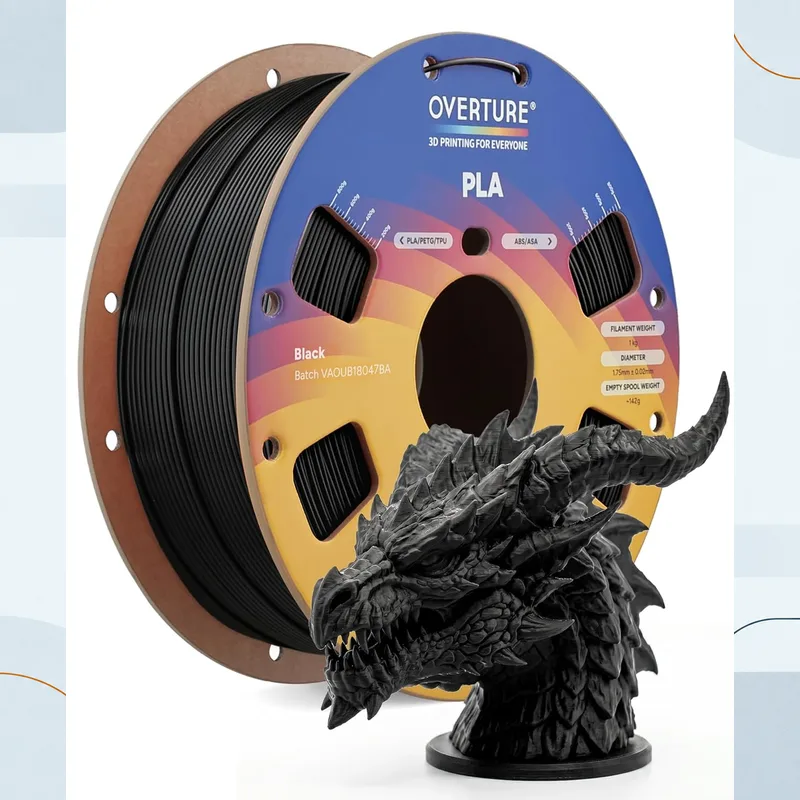
Amazon listing image · exact selected variant
OVERTURE profile for this line
OVERTURE High Speed PLA Filament, 1.75 mm, 1 kg, Black
Skip this if: the exact US child changes brand, model or line, material or capacity, diameter or weight, color, or generation.
Check OVERTURE listing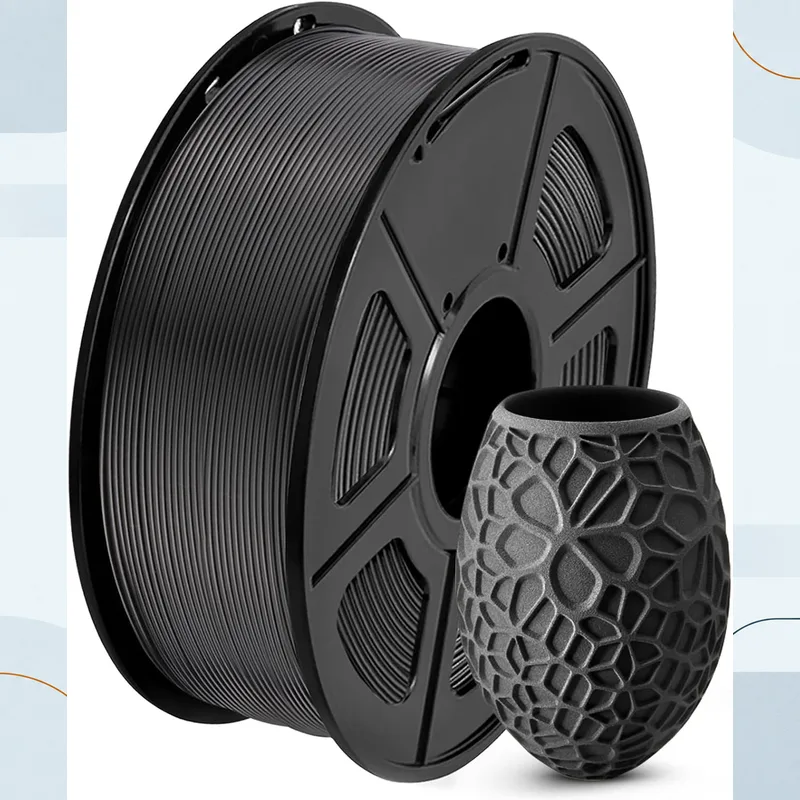
Amazon listing image · exact selected variant
Exact SUNLU PLA profile
SUNLU PLA Filament, 1.75 mm, 1 kg, Black
Skip this if: the exact US child changes brand, model or line, material or capacity, diameter or weight, color, or generation.
Check SUNLU variantCheck the selected product line, color, spool dimensions, and profile before printing. Listing variants can change.
Common questions
Are OVERTURE High Speed PLA and SUNLU PLA the same kind of product?
No. OVERTURE’s listed spool is High Speed PLA; the SUNLU spool here is standard PLA, not PLA Meta or PLA+. Compare the exact line and its own profile.
Does OVERTURE print faster than SUNLU?
The manufacturer pages list different advertised speed ranges for different PLA lines. Those claims are not a controlled comparison and do not predict the result on your printer.
Which one should I choose?
Choose by the exact product line, its supported settings, and color; then check that its spool fits your feeder. Neither listing establishes a quality winner.
Will the SUNLU spool fit AMS Lite?
Check the actual spool against Bambu’s published width and hub limits. SUNLU spool versions have mixed owner reports; the brand name alone does not confirm fit.
Is OVERTURE or SUNLU PLA better for Bambu AMS and AMS Lite?
Neither brand guarantees a fit. Closed AMS supports 50–68 mm width and 197–202 mm outer diameter; AMS Lite supports 40–68 mm width and 53–58 mm inner diameter. Measure the exact spool. For cardboard spools in the closed AMS, Bambu recommends an adapter to reduce slippage and trapped debris.